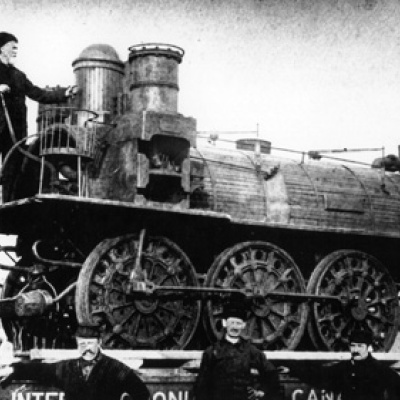
Built in 1838 by renowned locomotive pioneer Timothy Hackworth, Samson arrived in Nova Scotia the following year, shipped by the General Mining Association (GMA) alongside two other Hackworth engines, Hercules and John Buddle. Also aboard were engineer George Davidson and Hackworth’s shop foreman John Stubbs, who prepared the locomotives for service before returning to England. Davidson remained, spending his entire career operating Samson along the 10-kilometre route from Albion Mines to the loading ground at the mouth of the East River, where coal was transferred to ships bound for market.
Samson spent its working life close to where it is displayed today. The GMA locomotive shed once stood on the very site now occupied by the Museum of Industry.
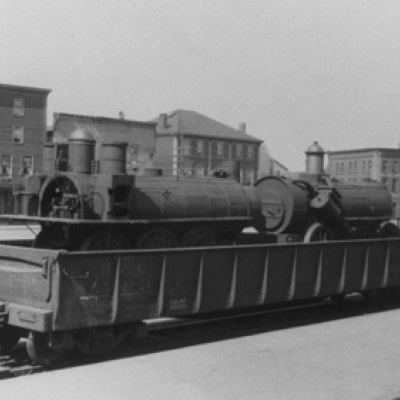
From 1839 to 1867, Samson hauled coal daily, before entering semi-retirement as a yard shunter until 1883. By then, it had become a historical curiosity. The locomotive was exhibited in Chicago at the National Exhibition of Railway Appliances and later at the Chicago World’s Fair. It remained at the Baltimore & Ohio Railway Museum until 1927, when it finally returned home to Nova Scotia. After periods on display in Halifax and New Glasgow, Samson found its permanent home at the Museum of Industry in 1990.
Samson Timeline
1838: Built by Timothy Hackworth, Durham, England.
1839: Shipped by General Mining Association to Nova Scotia with George Davidson who assembled the pieces.
1839-67: Used to haul coal from Albion Mines to the loading pier from ships at Abercrombie
1867-1883: Semi-retired as a shunter in the coal company yard.
1883: Sent to Chicago for display as an “antique” at the National Exhibition of Railway Appliances.
1893: Sent to Chicago, with George Davidson, as an display for the Chicago World’s Fair. Subsequently acquired by the Baltimore and Ohio Railway Museum.
1927: Displayed at the Baltimore & Ohio Railway’s Fair of the Iron Horse, Baltimore, Maryland.
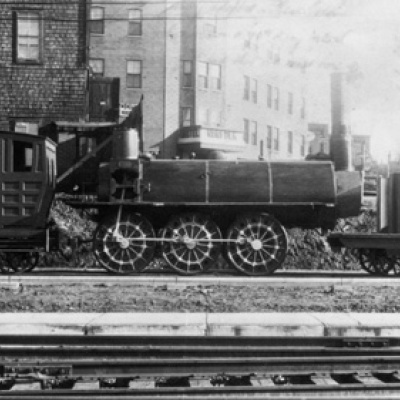
1928: Returned to Nova Scotia to be put on display with locomotive “Albion” near the Halifax CNR station.
1950: Returned to Pictou County and refurbished by Trenton Industries and Eastern Woodworkers.
1967: Housed in a special covered display built as a Centennial project next to the New Glasgow library.
1990: Transferred to the Museum of Industry.
1995: Restored to appearance at the end of its working life, and put on display in the museum near the site of the original Albion Mines locomotive shed.
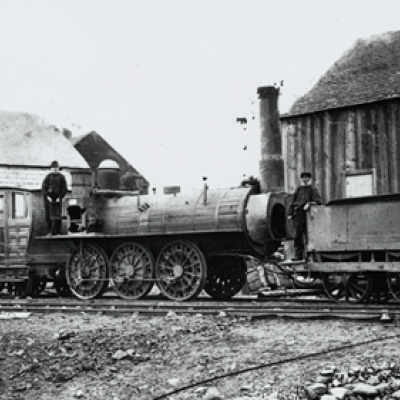


Albion
The Albion Mystery
The Albion locomotive is another British-built engine brought to Stellarton, then known as Albion Mines—by the General Mining Association. While its exact origins remain uncertain, Albion bears a front plate reading “Rayne & Burn, Engineers, Newcastle upon Tyne, 1854.” It was once believed to have been built by Timothy Hackworth, like Samson, but experts now describe it as belonging to the “School of Hackworth,” reflecting a shared design tradition rather than a confirmed maker.
One of Albion’s most striking features is its unusual angled cylinders, mounted high on the boiler and sloping downward at thirty degrees to drive the centre wheels. By the 1830s, most locomotives used horizontal cylinders, but Hackworth continued to favour angled designs well into the mid-nineteenth century.
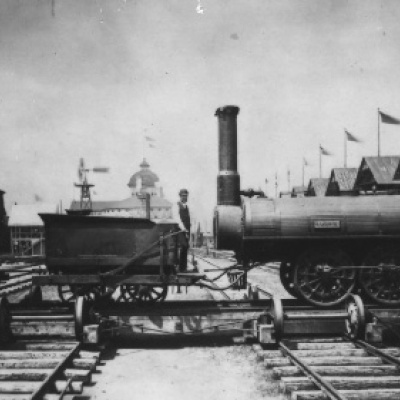
Despite the date plate, Albion’s true construction date is difficult to determine. Over time, various dates and builders have been suggested, and it is not even certain when the plate was added. Photographs from Albion’s 1893 exhibition show the locomotive without it, highlighting how gaps in the historical record can lead to competing interpretations.
After consulting with specialists, the Museum concludes that Albion was likely built between 1849 and 1854 as a contractor’s locomotive, possibly by Fossick & Hackworth or another builder working to similar specifications. Along with its sister locomotive Pictou, it may have been surplus from an unfinished order or briefly operated in Britain before being refurbished and exported in 1854.
What is certain is Albion’s working life in Nova Scotia. For nearly 30 years, it hauled coal along the Albion Railway to the loading ground at Pictou Harbour, retiring from service in 1886 when the line closed. In 1893, Albion was exhibited in Chicago alongside Samson. Both locomotives were later displayed at the Baltimore & Ohio Railway Museum before returning to Nova Scotia in 1927. By 1950, Albion was back in Pictou County, where it was displayed in Stellarton.

Photo Caption
Albion
Conserving Albion
Estimated to be the 34th oldest surviving locomotive in the world, Albion is remarkably well preserved. Its durability is due in part to the conditions under which it operated. Tasked with hauling coal from the mines to the port, Albion travelled short distances at low speeds. Winter harbour ice limited operations to about eight months each year, allowing ample time for maintenance. In addition, the locomotive burned coal rather than coke, which was less damaging to its boiler and contributed to its long service life.
To ensure the careful preservation of this rare artifact, the Museum undertook a detailed expert assessment to evaluate Albion’s condition and completeness. Missing, damaged, and replacement parts were identified, and later modifications were studied to better understand how the locomotive evolved over time. Following established conservation procedures, Albion was dismantled and meticulously documented so it could be accurately reassembled and its technical history preserved.
The conservation process revealed important insights into nineteenth-century locomotive construction. Albion’s frame, for example, consists of thick wooden timbers sandwiched between layers of wrought iron, a common design of the 1830s and 1840s. Evidence of a past collision was found at the left front corner, where the frame is bent and the wooden core had been replaced. Conservators also reinstated protective wood cladding that once shielded the fireman from boiler heat and had been missing when the locomotive arrived at the Museum.
Where possible, original components were conserved rather than replaced. Damaged elements, such as the heavily worn driver’s seat, were stabilized and returned to their original positions. Old paint and corrosion were removed from iron components, which were then treated with zinc primer and finished in matte black paint. Brass fittings were cleaned and left unpainted. The iron tires—likely installed in 1883 show little wear and were preserved through careful cleaning and repainting.

Photo Caption
Albion during the conservation process.